
I’ve been working on a new prototype which I’m calling “The Machine”.
It started about a month ago. I wanted to make a game to play with my family, so it had to be accessible and easy to learn. It should fit into a small box. And I wanted the players to be able to change the rules as it’s being played. It’s something I’ve wanted to try for years, so why not give it a go?
You might be wondering “Isn’t that just Fluxx?”. Not exactly. Back when I first read about it, Fluxx sounded incredible! Fun concept, easy to teach and to set up. But when I played it I found it far too random. The game dragged on as players stole cards from each other and kept changing the goal. It made me think “What would my take on Fluxx be?”.
One of the challenges of a designing a game like this is that you have to make two games at the same time. There’s the game the players play from turn to turn and there’s the meta layer of rules which can be changed every so often. In a way, it’s similar to Fortune Tellers, a design I often return to but have yet to complete. You have to make sure that no matter how twisted the rules get, the game doesn’t get into a state where it cannot end.
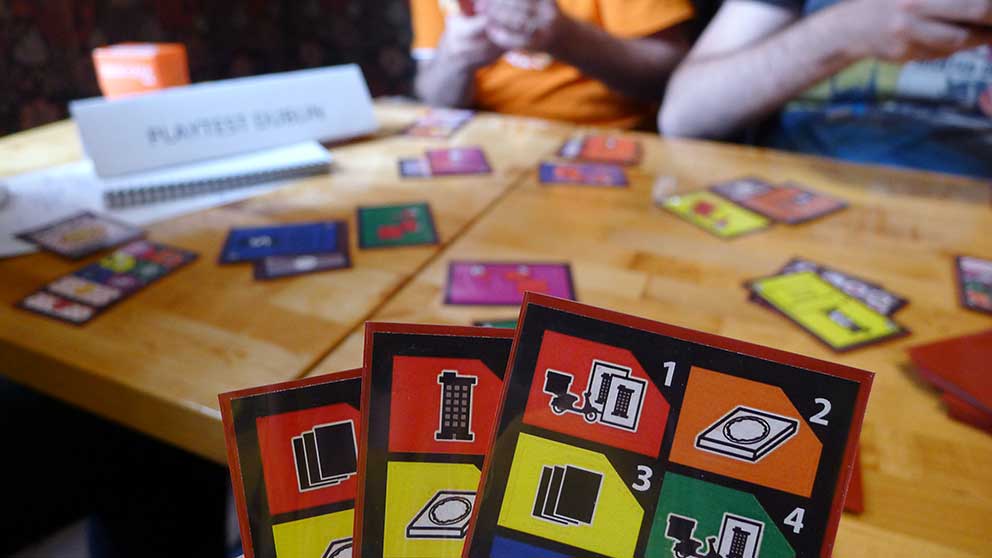
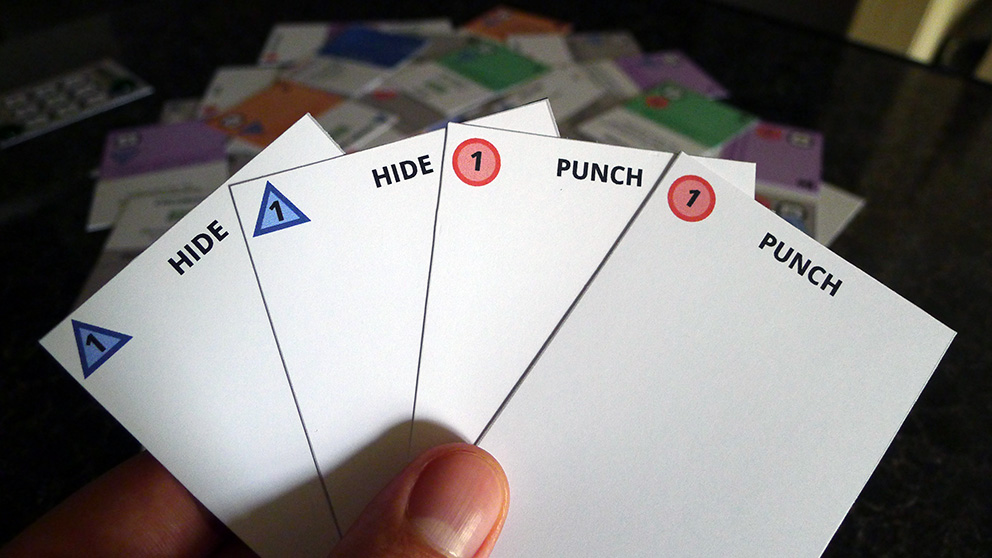
To make it accessible, I started sketching rules on cards. I don’t want players to have to rely on their memory as the rules change, so they go on the table where everyone can see them.
I first played around with action programming and found that it could quickly get out of hand. If the rule sequences grew every turn, the game’s footprint would keep increasing, and so would the length of every turn. And if every player was too engrossed by their own sequence of rules, it would be a more solitary experience than I was after.

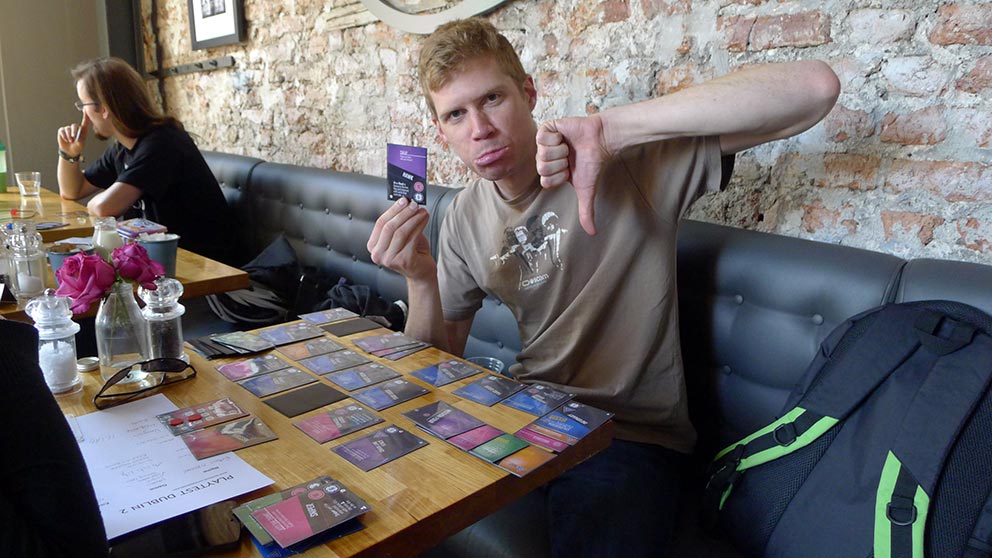
I landed on the following: There is a line of action cards on the center of the table, which will resolve from left to right. On your turn you add a new card to the end of the line and resolve them in order. Then you take the first card into your hand. This allows the turns to keep changing without growing endlessly. Timing is an important factor, because when you play a good action it will stay in the line for a few turns and other players will get to use it too. Since there’s only a handful of actions the game is very easy to get into. The fun part is combining them in surprising ways.
This felt novel and exciting! However, research showed that a similar system had been used in the game Impulse, which was far more complex than I’d like this one to be. While not totally original, it felt like there was design space to explore.
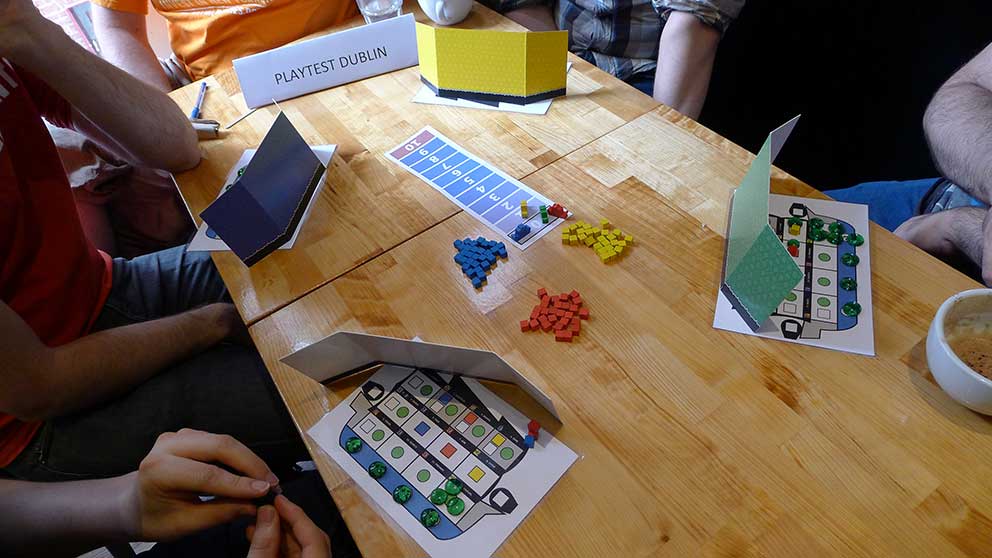
It’s not easy to find a suitable theme for this game! There aren’t too many ways to explain a sequence of actions that you cannot rearrange, at least in a way that doesn’t feel forced. For now I went with: The players are factory workers who need parts to complete their orders. The parts are built by a machine that is very powerful but slow to adapt to change. Hence, “The Machine”.
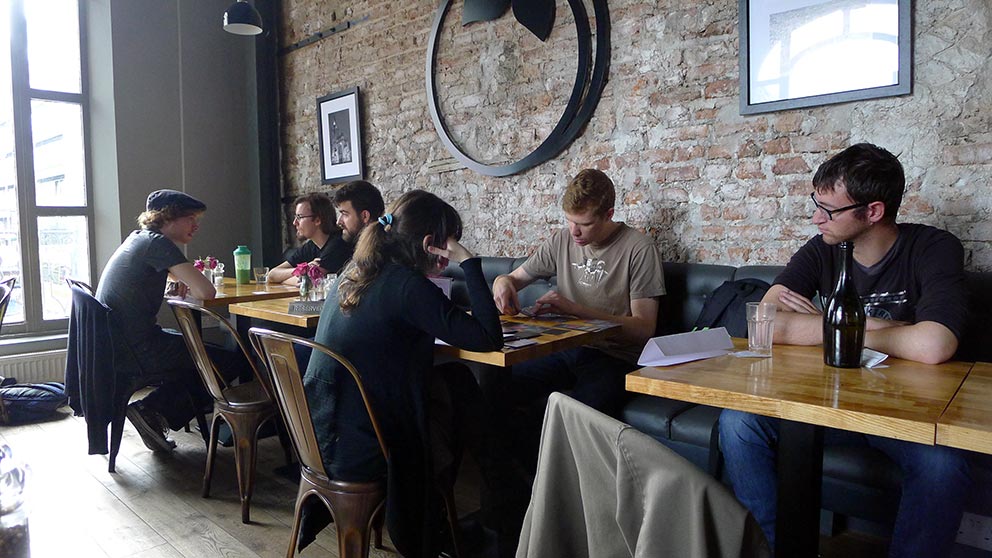
I had never seen a system like this in action so I was very curious to try it out. I was shocked by how well the first playtest went. Teaching it was a breeze, the game went smoothly, the players liked it and it took exactly as long as I was going for. There was almost nothing to change!
It’s a good game but I think it would be great. I already have a few things in mind in order to make it more tense, exciting and allow for more varied strategies. Stay tuned!
If you don’t want to miss a post, you can subscribe to get them via e-mail:




 Games by Manuel Correia