Playtest updates – sacrificing “Sacrifice”

boardgame prototype, playtest, Sinking

The second playtest was a lot of fun, but it was marked by the most game-breaking rule yet, “Sacrifice”.

My intentions were to create opportunities for losing players to get back on track, but I had no idea it would be abused as it did. As soon as I taught the testers about this rule I could see their eyes shine as their plans formed.

I knew I had made a mistake, but I let the game start like that anyway.

The players started using it on the very first turn, which is something I expected. What I did not expect, though, was to run out of crew tokens. This rule is out!

This lead the way to a new idea that increases tension and reinforces the game’s theme. Not mine, but Jorge Graça’s. I just adapted it to fit the game. Now you’ll have a chance to control the speed at which you are sinking by assigning crew members to drain the water out. Betting big on an action means you’ll have to take them out of there and risk sinking faster.

Also, there’s an 8 crew member limit now.

The arrows on the side of the actions were barely used as a reference at all, so I’ll keep the standard from left to right, up to down order and update them for reference’s sake.

I’ll give the players more opportunities to chose which other player’s crew members and resources are they affecting with the most expensive actions.

I have to mention Nuno Carreira found a design flaw and pounced onto it like a hungry cheetah, winning the game in a way I hadn’t thought of before. Thank you man! I’ll fix it in time for the next playtest.

Next up: both board redesigns and an updated prototype!
Prototype updates – tidying up the board

boardgame prototype, Sinking

The first playtest sessions made me change several parts of the player boards.

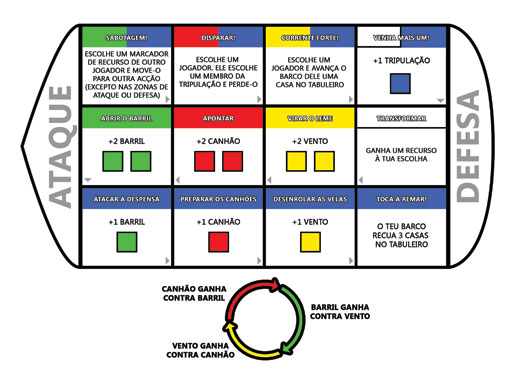
First I rethought the relevance of some of the most expensive actions and added new actions which could be paid using any resource token. It’s easy to end up with duplicates of any given resource and not know what to do with them.

Then I switched the order of every action on the board and placed arrows on the lower corners of the actions so the players know in which order they get resolved. It was left to right, top to bottom the first time and players got confused. Now its order curves as you reach the edges, so they can follow a line from start to finish.

Even though the Attack and Defend rules changed from the first playtest session their titles didn’t change (yet!).

The boards were printed in slightly double the size to fit multiple tokens in the action zones – and that made the current board shields useless.

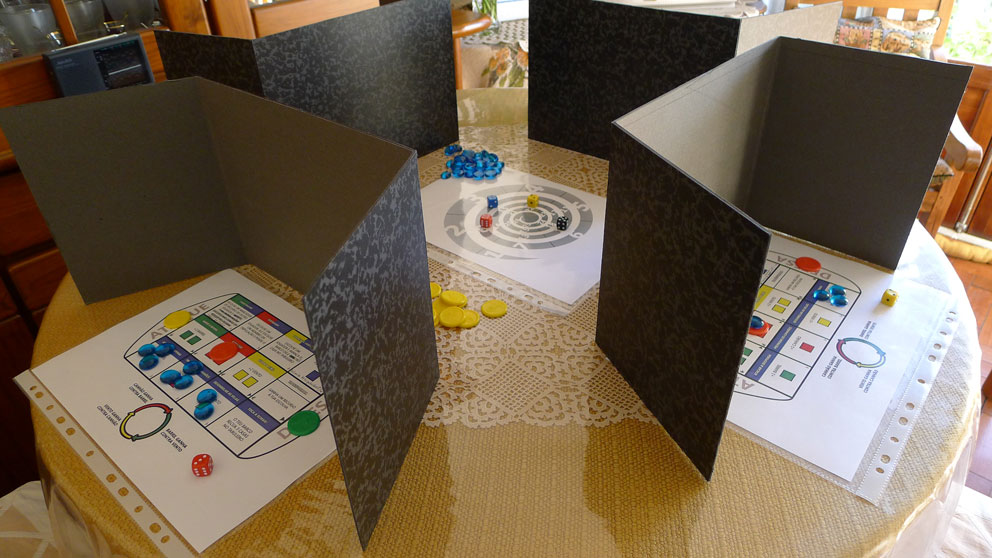
The previous shields were too small and light, and could easily fall down if you weren’t holding them in place, so I got new thick cardboard to hide the boards. Now every ship is a fortress! They’re seriously huge, heavy and look like Dungeons & Dragons DM screens. To be honest I’m sort of worried they’re too big.

This is how it looks now when it’s set up:

Next up: what did the players think of it?

First Playtest

boardgame prototype, playtest, Sinking

I was warned by a veteran tester that most prototypes have really rough first playtests. A lot of them don’t reach the end because of some unforeseen design flaw, and some don’t even go beyond the first turn.

So, how did the my playtest go?

It went really well. Players enjoyed themselves and told me they want to play the next versions, so I think I’m off to a nice start.

It’s amazing how they’ll will ask questions and find out strategies you weren’t anticipating. I spent as much time playing with them as I did writing notes about things to change for the next time.

I played two full games and some of the rules changed between them. I corrected a couple of things in the game boards and welcomed four new players. The new fixed rules were taught and I let them play as I peeked around and took notes. One of them saw a loophole and tried to break the game using it. I was glad to see the current rules balanced it out by themselves and he didn’t end up winning.

I intend to take the dice out of the game. It can create some tense but unfair outcomes when the effect of an attack or tie depends on a random factor. Its ironic though, because the original idea for the game came up as I was trying to design an original dice game.

It’s hard to recover your position when an overpowered player constantly attacks you, so I’m going to try something new – a turn phase called “Sacrifice”. At the end of the turn a player may sacrifice its position on the board for new crew members. Sounds a bit unbalanced, but I’m curious to see what the players will do with it.

The board shields were way too light and small. The most obvious situation was when a player made a specially clever bid and proudly laughed while looking at his board. The shield fell down, and now everyone got a chance to look at his boards and change their bids accordingly.

It’s really good to see that people enjoyed it and gave me a lot of suggestions as they played and after the games ended. They are a very important part of it, and the game is taking shape with every question and strategy I see.

Onwards to the new set of rules and prototype 2!

First Prototype

boardgame prototype, Sinking

After sketching out the rules I realized I don’t know a thing about protyping a boardgame. I didn’t let it stop me though, and started planning how to distribute the actions across the player’s board:

That night I turned it into this so I could easily print one for each player and modify it whenever necessary, along with a spiral board to track the ship’s situation.

I searched around for tokens and I remembered this game by Dom Quixote called “Mar Largo”. It had some nice colored coin-like pieces that I could use. The blue bead tokens are sold as interior decorating fluff to fill vases and aquariums but they work really well as game tokens. The shields are black thin cardboard and the dice are (very cheap!) warhammer dice I got from ebay.

This is what it looks when it’s all set up. Each player gets a ship and a screen to cover their bids, the resources and crew members are piled up and the spiral at the center of the table is used to track the ship’s state.

It’s ready for its first playtest.

With this I learned that making prototypes is not hard at all.

The idea

boardgame prototype, Sinking

So, about that idea…what is it?

Well…in this boardgame you’re the commander of a sinking pirate ship and you must decide how you send off your crew to complete several tasks and keep you afloat.

You do this via a blind bid playing method. Players hide their playing board, place their bids on the several actions, all reveal their bids at once and succeed in the ones where their bid was the highest. That means you can get a lot of actions done for cheap if you pay attention to what the other players are doing – and bet on what they’re not.

This allows everyone to play in simultaneously turns, which keeps the game flowing.

It’s a tight situation where players have to make sacrifices, play tricks on others and attack them to survive, but you know how pirates are. They’re ruthless!

The last player to stay above the water wins!

I won’t write the detailed rules because they keep changing with every flaw I spot at playtest sessions, but stay tuned for the next step: prototyping!