Agent Decker

Agent Decker, boardgame prototype, competition

P1070038

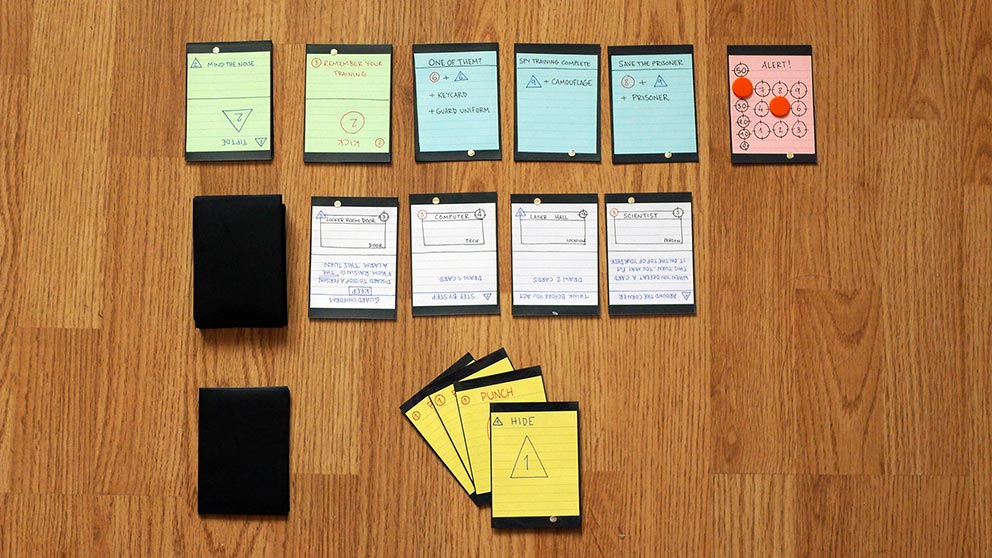
Agent Decker is a mission-based deckbuilding game for one player where you’ll acquire gear and skills by facing obstacles. The alarm raises every turn, so you must pick who you take out. Do you go for the cool weapon, or take out the security camera?

You’re a rookie spy straight out of spy school, and the yellow deck of cards represents what you can do: Punch or Hide.  These are the base cards of each of the game’s two currencies, Violence and Stealth.

P1070043

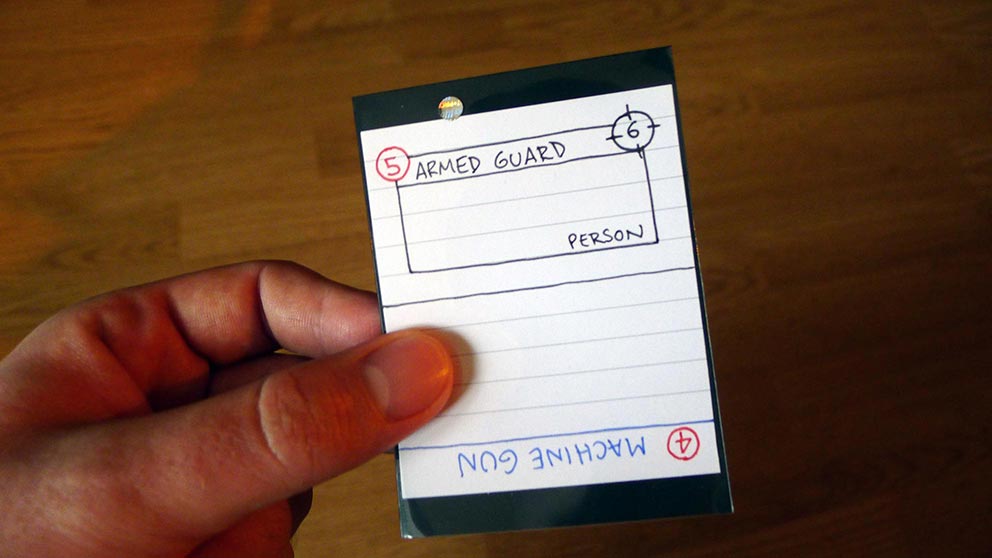
As you defeat obstacles you learn new skills and get gear. For example, you can defeat an Armed Guard

P1070044

…to get a machine gun! That will give you four “Violence” when it appears again.

I’m developing it for the 2015 Solitaire Print and Play Contest on Boardgame Geek, so it will be available as a free print and play PDF when it’s done. For now there’s only the handwritten paper prototype, but soon there will be a prototype version you can test. It’s the first time I’m letting the internet play one of my games before it’s finished, so I’m pretty excited (as well as terrified)!

I’ll post about the game’s design and progresses here, but the best place to follow every step of the development as well as player feedback is at Agent Decker’s WIP thread.

Round and round

boardgame prototype, Carousel, Multiuniversum, Pizza-go-round, playtest

P1070053-small

Just like the bikes go round and round, so does the game!

Changing the main goals in Pizza-go-round brought several issues to light, so additional tweaks were required. I was fortunate to get really good feedback and design suggestions from Vital Lacerda and now the game’s working well, so here are the changes:

First up, I replaced the standing order lineup for small piles of orders on the buildings themselves.  Instead of picking up orders to fulfill on your own, you prepare the ingredients and go to the building in order to deliver the pizza.

This increases player interaction and competition. When you see other players chop ingredients you can guess what orders they’ll be going for, and the race is on! When that order is delivered, that player keeps the order card for the final scoring and a new one is revealed. The game is over when four of the piles are empty.

That means the “Out of gas” card is out too. How could it stay, since the single pile of orders isn’t there anymore? The players weren’t big fans of the semi-random end of the game anyway, especially because they were penalized for any leftover ingredients they had. There was absolutely no downside to removing this from the game.

As you can see in the picture, the buildings have abilities now! Each one has a unique ability which is activated by the action cards. Using them is simple: play the “building” action to activate the building where you are. This creates a lot of possibilities both for the players and for the game, as building cards can have two different sides.

There’s also a “deliver” action you can use when you’ve prepared the right ingredients for the order, and a brand new one I’m experimenting with: “recycle”. Recycle allows the player to discard any number of cards from their hand in order to draw more from the deck. This allows the players to throw away cards that aren’t useful at the moment and to press their luck, while keeping the deck flowing.

Lastly, the direction of the bike doesn’t matter anymore. I thought the players would be confused now that the ramifications of their actions change, but actually it was the other way around. It flows better because it avoids the situation where a player wants to move but suddenly can’t because everything is pointing to the wrong direction, and removes the “fiddlyness” of having to turn the cards in a specific way – particularly noticeable when the bike cards are stacked in a single building.

How about a slice?

Pizza-go-round!

boardgame prototype, Carousel, Multiuniversum, Pizza-go-round, playtest

P1050683s

Come to think of it, Carousel‘s theme clashes with the game mechanics. The postman theme doesn’t really work when you’re taking things from the board and keeping them for yourself.

To fix this, I added recipients to the envelope cards. Instead of picking them up, now you had to deliver them at the right location to get those precious points. This worked very well. It brought a new set of objectives to the players, and the chance to interfere with the other players.

I was having a lot of fun, so I tackled on another issue that had become apparent during playtests. First-time players were intimidated by the amount of possible actions during a turn. To avoid that Analysis Paralysis, I decided to cut two actions from the cards.

I still haven’t found a reliable system to distribute the actions throughout the cards the way I want, so I was forced to do it manually. That’s a pretty radical change, because it requires brand new files for all the game.

Is that bad?

On the contrary, it’s a great opportunity to improve the theme! I often think about the mechanics first, and would like to try developing both at once. So…

P1050665s

I bring you “Pizza-go-round”!

Instead of a van you’re driving a pizza delivery bike. Orders replace the envelopes, and have varying ingredients and rewards. Action cards have six actions instead of eight, along with an ingredient. You can play actions to move between buildings and ingredients to complete your orders. The game ends as the “out of gas” card pops up from the orders deck.

The playtesters had a lot of fun! Although this is a branch, my favorite bits from Carousel are still here, along with a clearer set of goals and a more appealing theme.

Pick a Pet released!

Pick a Pet

Pickapet_site-banner

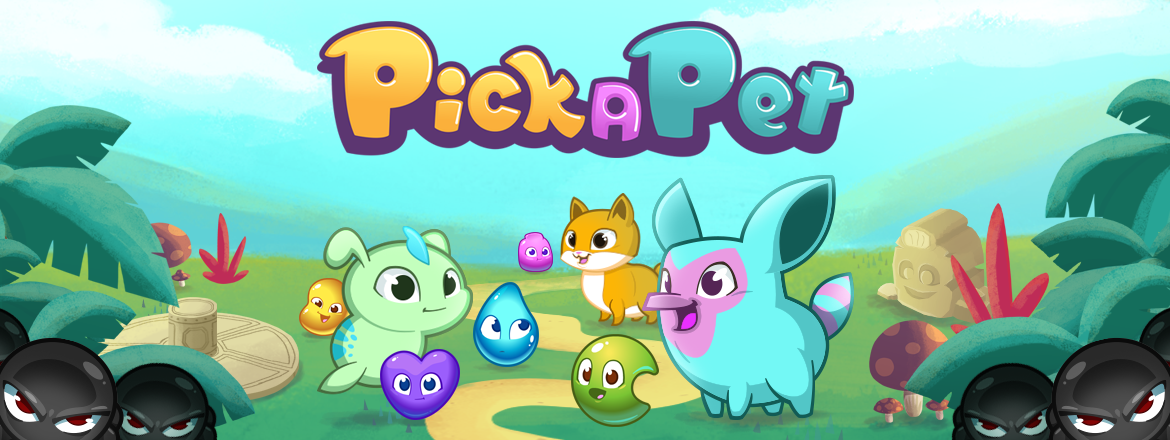
Pick a Pet is out for iOS and Android! It’s a gem matching puzzle game where you collect and evolve pets. Each one has a specific power, and the levels are designed around them.  As you feed them, the pets evolve and get stronger!

I had never worked on a game like this, and learned a lot from it, especially level design and how to tune difficulty in a puzzle game.

Check it out! It’s free, so there’s no excuse.

“Don’t Say!” at Global Gamecraft 5

boardgame, boardgame prototype, competition, Don't Say, Game Jam

P1050529

I went to Global Gamecraft 5 with a few mechanics I wanted to try. I just had to fit them to the theme, right? Wrong. When the theme was revealed (“Party Game”, or a game you could play at a party) I couldn’t use them, so I started from scratch.

It needed to cater to a big number of players (infinite, if possible!), and ideallly it would also be fun to watch. First, I played around with this idea of a game about cupids, and people trying to find their match by asking questions to the group. I liked the concept, but it sounded a bit too easy and fast to play.

I wanted the game to be different from the other games I had made so far, and I wanted people to interact with each other in a genuine way – not because the rules say so. In all the party games I know, the ones that involve drawing are always a special kind of fun. Everyone interprets the drawings in a different way, and often be hilariously wrong.

P1050535

So this is what I came up with: a player gets a card with a surreal image and must describe it to the others, who must draw it as best they can before the time runs out. There are two words the player can’t use while describing them, (and they’re pretty obvious!), or he’ll lose points. After the timer ends, players hand their custom notebooks to other players and everyone’s drawings will be rated for accuracy. The one describing is rated too! In the next round, another player will be describing, and everyone else draws.

The best thing is: you don’t need to know how to draw! You get points by having the right elements in the right place, now how they look.

I couldn’t play it myself because I had made the illustrations which were being described, but these playtests were a lot of fun to watch.

P1050543

I won’t be developing this one further because it draws a lot from two other games: Identik and Taboo. Still, it was a great experience and the players loved it too.

Thank you all who played it! I look forward to the next 8 hour jam.

Contactics is now available for download!

boardgame prototype, Contactics

Imagem

Here it is!

Now you can get the print-ready files for Contactics! It is available as a “pay what you want” download. Every little bit helps to fuel my next games!

It is distributed under a Creative Commons BY-NC-SA 4.0 license, which means you can use and remix the game for free, but you can’t sell it without permission.

Have fun!

Contactics – part 2: Bringing the game to the players

boardgame prototype, Contactics, event

Without a player, there is no game. Following up on my last article, here’s how I brought my game to the players.

EGX Rezzed: ONE MORE GAME ON THE SHOW FLOOR

Other than the #Contactics hashtag and posting the game on Twitter, Facebook and Reddit, I didn’t have any plans for its distribution.

“I’ll improvise. It will be fun!”

The official twitter account for Rezzed was talking about all the cool games that would be playable on the show floor, and I mentioned mine. People asked for copies, so I made sure to meet these people and hand them some.

I didn’t want to take the game developer’s hard earned space, so I placed some cards around the food hall and tweeted about it.

P1050224

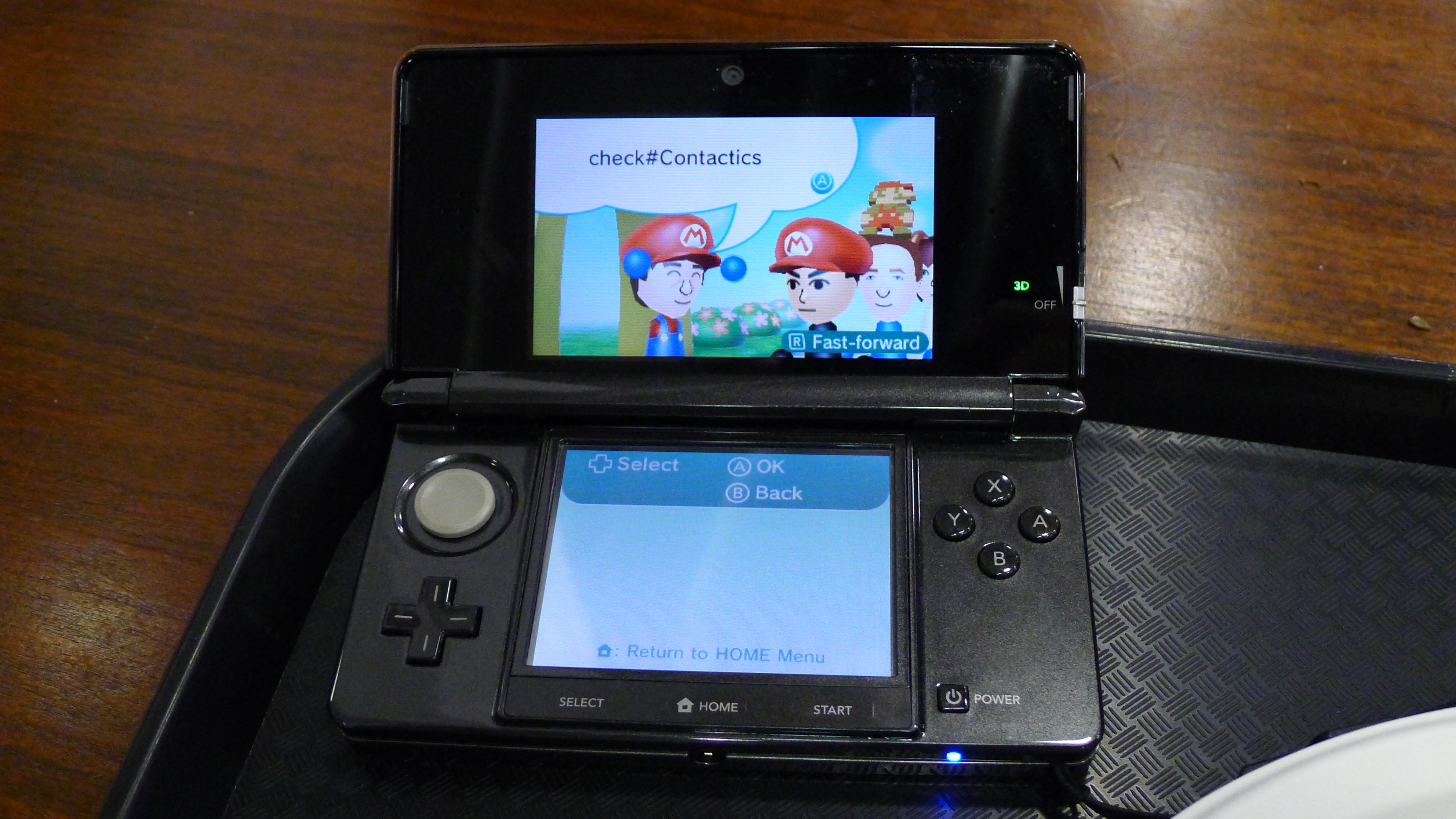
There were so many Nintendo 3DS consoles around, I changed my Streetpass greeting to mention the game!

It was a great chance to meet game developers I admire: Rami Ismail (Vlambeer), Mike Bithell (Thomas Was Alone), Dean Hall (DayZ), Ed Stern (Splash Damage), Paul Dean (Shut Up & Sit Down), Team 17, Creative Assembly, Destructoid and Boneloaf to name a few!

I handed each a copy and their faces lit up once they realized what it was!

“I brought home invaluable amounts of motivation.”

GAMASUTRA: THE first article

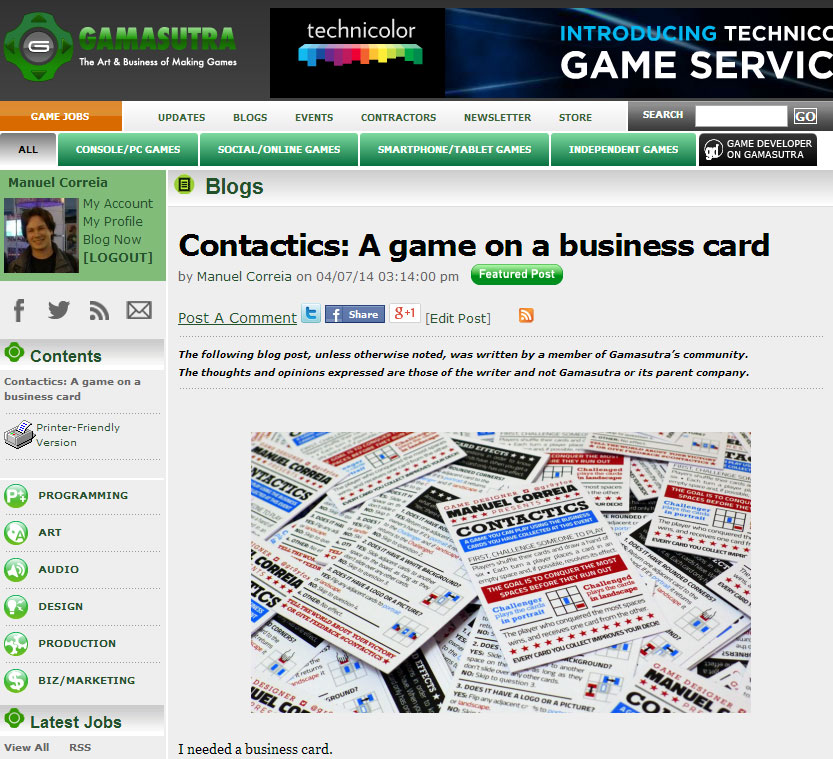
After coming back, I published my first article on Gamasutra. It got featured, and stayed on the front page for two days! The readers shared it, which lead to the game popping up in a lot of websites.

If anyone mentioned the game on twitter, I thanked them!

gamasutra

This was a big milestone for me. Having learned a lot from reading articles on Gamasutra over the years, it was my chance to help other aspiring game designers.

MCM Dublin Comic CONTACTICS

Next up, I brought it to the first MCM Dublin Comic Con!

P1050507

Canada Photo Convention

I left the coolest one for last! One of the organizers for the Canada Photo Convention saw my game online and thought it would be a great way to break the ice and get people networking.

CPC2014

She asked me for some adjustments to better suit photographer’s business cards, I looked up Creative Commons and, starting from April 22, the game will be at Canada Photo Convention 2014!

“Suddenly I have players on the other side of the world!”

Better yet: every person who registers will get a copy of the game and the one who collects the most business cards during the event will get a prize!

Designing the game is just the start. Don’t overlook the marketing aspect! Without a player there is no game.

Contactics – part 1: Game Design

boardgame prototype, Contactics, event

P1050125s

I needed a business card.

Soon after booking my tickets to EGX Rezzed I realized there were only a few old cards left. While I could just print more of those, they felt outdated. They were made three years ago and they represent a very different phase of my life.

“Could I fit a game there?”

It was not the first time I had poked around the idea of handing out a game as a business card. I remember checking the prices for printing Carousel to give at events, but the printers would only accept orders of large quantities and that made it very expensive and cumbersome to carry around. Worse of all, if it was cumbersome to the person I was handing it to, that would have ruined that first impression.

I wanted a simple game, which would not take long to learn but dynamic enough to provide different playthroughs. I wanted to prove it was possible.

The following were the main design issues, and how I solved them:

Design issue 1: Components

What will the players play with? Can the game be in the card itself? Sure, it could be a crossword puzzle which would reveal one of my contacts when complete, but that wouldn’t be that original and, frankly, it could turn out boring. It would also require some work from the person, and I didn’t want to create an obstacle.

Then I thought of using coins, but this idea was short lived. Even if they were used as tokens, I didn’t want money to be a part of this. Also, it would be too easy for the player’s coins to get mixed, and that could lead to heated arguments.

“What will the developers carry with them at all times? Smartphone? Keys? Wallet?”

Then it dawned on me. Business cards! Just like me, the other developers will be networking. Some might be looking for publishers or teammates, and they will be handing out their cards to promote themselves and their games.

My card only needed to provide the rules for you to play, and the cards you collected would form your deck. It fits the networking theme. Better yet, if the winner got one card from the player, it can even facilitate it!

Design issue 2: Whose cards are they?

I couldn’t expect each player’s deck to have a unique look, so I used the card’s orientation to define that. One player pays their card in portrait and the other in landscape.

P1050094s

Design issue 3: Filtering types of cards

The cards can have so many shapes and sizes but I had to find a way to make them all fit. My solution was to create a system which would filter them into categories. You go down a list of features and you stop once one matches. Each category would have its own special property, which would take effect when you played it.

Initially I had a lot of categories, but I realized it could be really boring to go through the list, especially when learning how to play. The size of the card was also a factor which contributed to having only three (and an “other” category for unpredictable ones that don’t fit the list).

Design issue 4: Balance

I couldn’t really predict the shapes and features of cards people would be handing out. I made a rough estimate by looking back at the cards I had been given at such events and from print shop prices. Even if these estimates were right, I had absolutely no way to predict which ones the people would have with them at the moment, so I left that open.

This turned out to be a good decision, because that brought deck building to the game! It gave the reward some appeal, and a great excuse to play more than once as your deck improves.

Design issue 5: Fitting everything into the card

I wrote the rules down and instantly noticed they were a lot longer than I could fit on a card. I started searching out for alternatives (like foldable cards, which would give me four faces instead of two), but Sara Mena quickly mocked up a couple layouts which proved me it was possible. I then simplified the text and used icons to convey mechanics, making it more appealing.

“When it was done, I had more than a card. I had a fresh idea.”

This card represents what I like to do the most, and it was built around a solid core concept: More than just having ideas, I can develop them, use the limitations in place and work with what you have.

It’s exactly the first impression I wanted to convey!

Stay tuned for part 2, where I talk about how I released Contactics.
Dublin Gamecraft – Unplugged

boardgame prototype, competition, Game Jam, Grow your own Adventure

GrowYourOwnAdventure1

I spent last Sunday afternoon surrounded by fellow creatives at Dublin Gamecraft Unplugged. We had about 4h30m to make an analog game. Yep, that’s right! No videogames this time.

The theme was “Grow Your Own”.

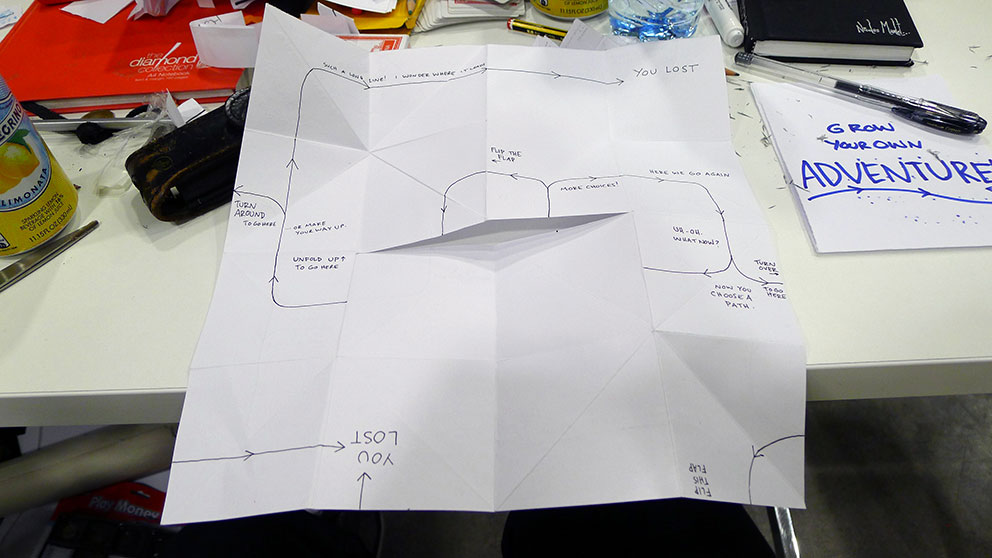
I knew we didn’t have much time or materials but I wanted to make something different. A simple adventure game that physically grows as you play. I ended up with “Grow your own Adventure”: an interactive story where you follow a line, choose your path and your choices alter what comes next.

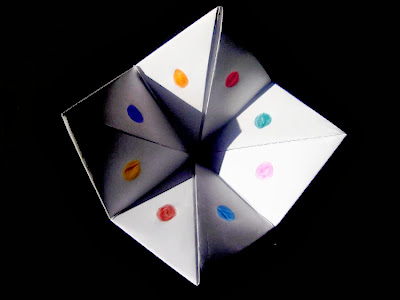
I started folding to see what I could do with one sheet, and accidentally got to this.  Twice! If you had asked me to teach this to you I couldn’t remember how to, but muscle memory brought it back.

GrowYourOwnAdventure2

I kept folding and realized you can make very interesting “page turns” from just a single cut in the middle of the sheet. It allows you to hide surprises but, most importantly, make choices that change the layout.

I started drawing a line and improvising. Taking notes, seeing how far I could go with it and how many “faces” I would be able to write on.

In the end, I got to something I’m very proud of. It’s an interactive story system you can fit in your pocket. Your choices change it, so there’s some replayability. It comes from a single page, which makes it possible to distribute as PDFs.

You can see the other projects here.

Fortune Tellers

boardgame prototype, Fortune Tellers, playtest

P1030454

My new game is called Fortune Tellers. It’s about predicting the future.

The idea started as a friend told me he wanted to make a game about Nostradamus. He is a great designer with several published games, but he didn’t know how to turn it into one – just found the theme appealing.

A lightbulb lit in my mind!

A while ago I sketched out a game where you combined words to make stories. While interesting as a concept, it’s too vague for a game. I needed something to narrow these stories to something relevant to the game, so this made perfect sense.

I thanked him, he said “I can take the Nostradamus idea”, but I said it’s still his. I don’t want to get stuck with a historic theme. All I needed was the bit where you predict stuff, because shady fortune tellers sound a lot more fun to me.

So that’s it: a game where you’ll predict what the other players will do during that game. You can get more verbs to predict new situations, and more assistants to do more things every turn. In short, two games at the same time!

I was invited to the latest Arcádia meeting two days beforehand. I didn’t want to wait a whole month to try it out, so I hurriedly made the first prototype. Some parts were improvised, I just wanted to check if it was fun to play – and it is!

The players liked it a lot. The “Aha!” moment when a prediction you made happens is a lot of fun, and something I haven’t felt in many games. Of course, it needs a lot of tweaks, like fixing the game’s economy, making matches shorter and even more types of possible predictions. I’m working on that.

Stay tuned! I predict it will be a lot of fun.