Cortiça Part 6 – Release

boardgame, boardgame prototype, Cortiça, crowdfunding, designer tips, game design

Cortiça was officially released in April 2024 through the Board Game of the Month Club, Button Shy’s subscription service where backers receive a new game every month. This meant that the physical game was not sold on Button Shy’s store – except for a brief moment when 30 or so spare copies were available and quickly sold out.

One of my favorite things about Button Shy is how open they are to distributing their games as Print and Plays, which are files you can use to print your own copy. This has a lot of advantages, from making the games cheaper (the files are cheaper than the physical game and there are no shipping costs to pay), it is more environmentally friendly because it skips the logistics of shipping the games around the world and it keeps the games available for longer because the digital copies don’t run out. 

When Button Shy does crowdfunding campaigns for their games they always include the option to back it as a Print and Play. They also run PNP Arcade, an online shop for print and plays, where you can also find Cortiça.

It was a joy to receive my copies of Cortiça. Due to the high shipping costs (and now tariffs) from the USA to Europe, up until now all of the Button Shy games I had played were Print and Plays. The first Button Shy game I’ve held in my hand was the one I designed myself! I took the opportunity to take some photos: 
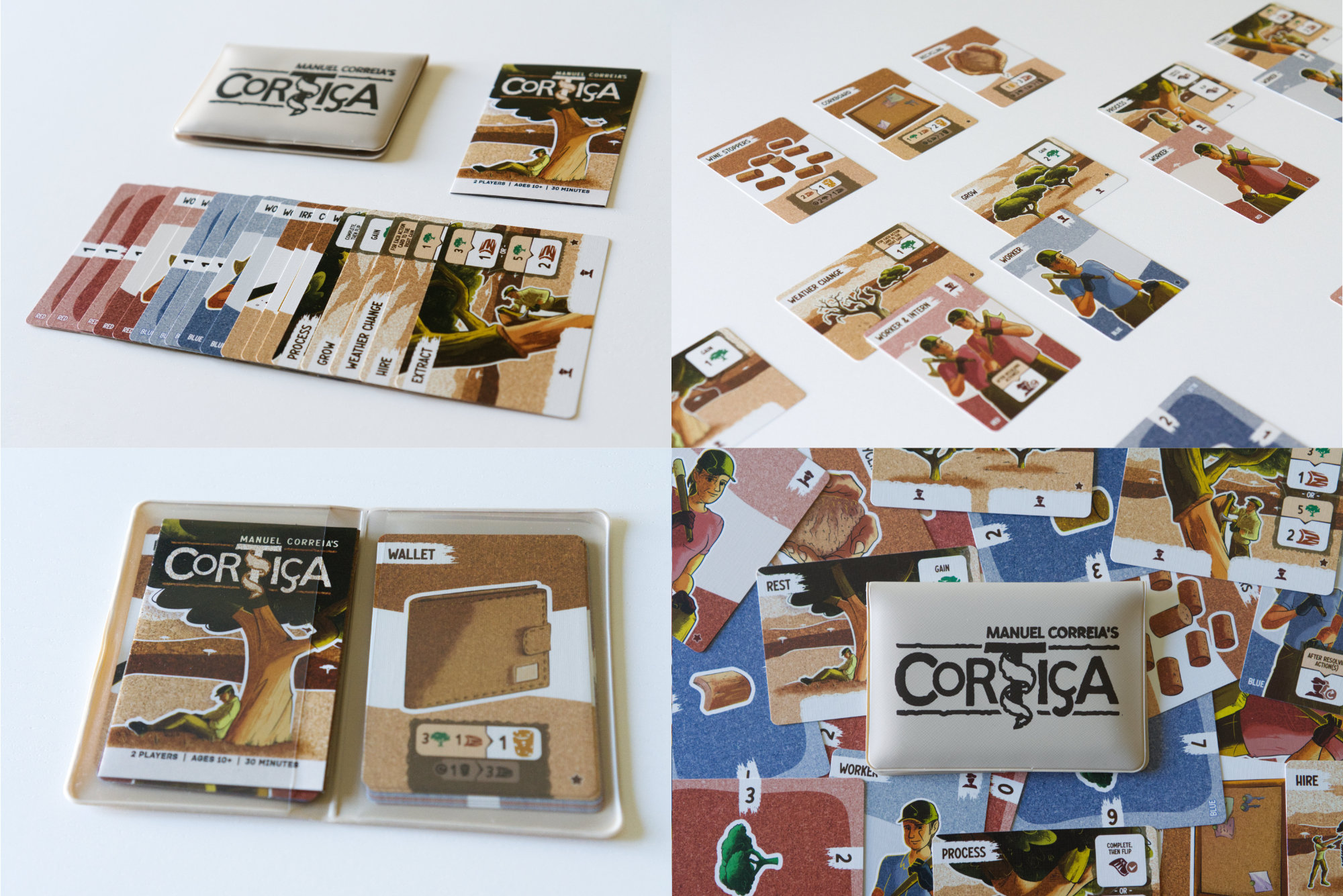
You can see more photos on its gallery on BoardGameGeek.

If you’d like to get a physical copy of Cortiça, good news! Cortiça is a part of Button Shy’s Reprint Campaign which is currently running and will last for 6 more days.

I’m very happy that the game is getting a wider physical distribution and I hope that everyone that wants a copy is able to get one. If you’re reading this at a later date, I’m sorry you missed it!

Before we go, I’d like to highlight these fan projects from the Button Shy community:

  • Ava Jarvis (sinopiasaur) created an elegant solo variant that allows you to play the game whenever you want! For such an interactive game, I am impressed by how well it works. I invite you to try it. The rules are available here.
  • Lee Smith (DragonWizard9) opened my eyes to another advantage of Print and Plays. You can print the games in different sizes and materials! First they printed a miniature foil version of Cortiça and they took it one step further by making a version out of cork, with a box and everything! How cool is that?
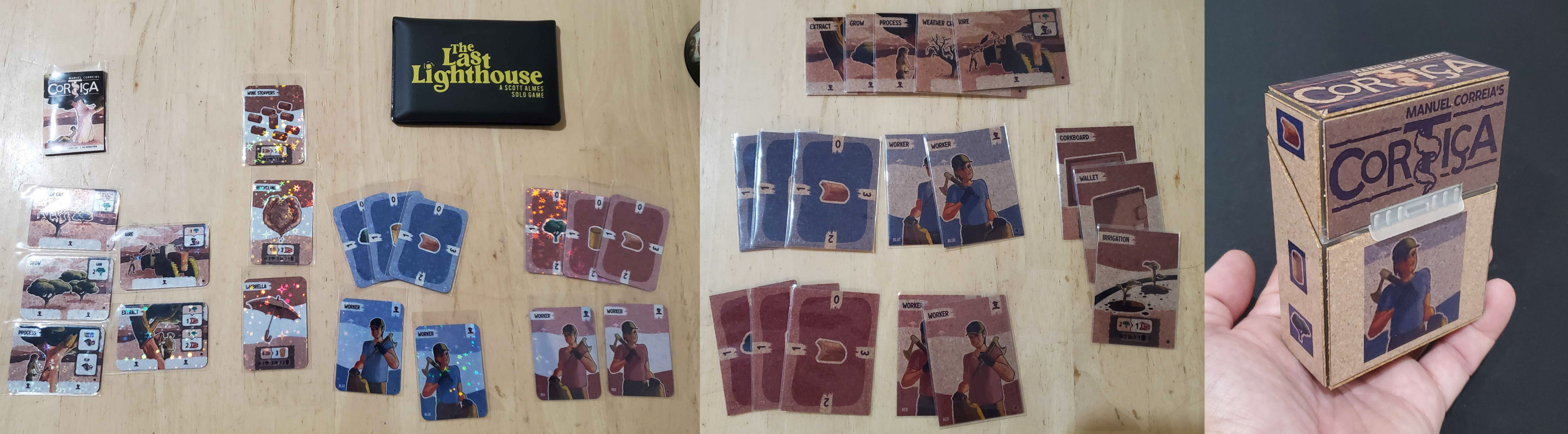
The best part is this happened before I had revealed the earlier plans for a cork version!

And with this, the design diary for Cortiça is up to date! If you’ve just found this article and would like to read it from the start, here is Part 1.

If you don’t want to miss a post, you can subscribe to get them via e-mail:
Cortiça Part 5 – Publishers

boardgame, boardgame prototype, competition, Cortiça, designer tips, game design

In the following year Gil d’Orey from Mebo Games contacted me about another of my prototypes and since they’ve published several games with Portuguese themes I brought up Cortiça. He tried it out, liked what he saw and for the next months we iterated on the game, both in terms of gameplay but also production.

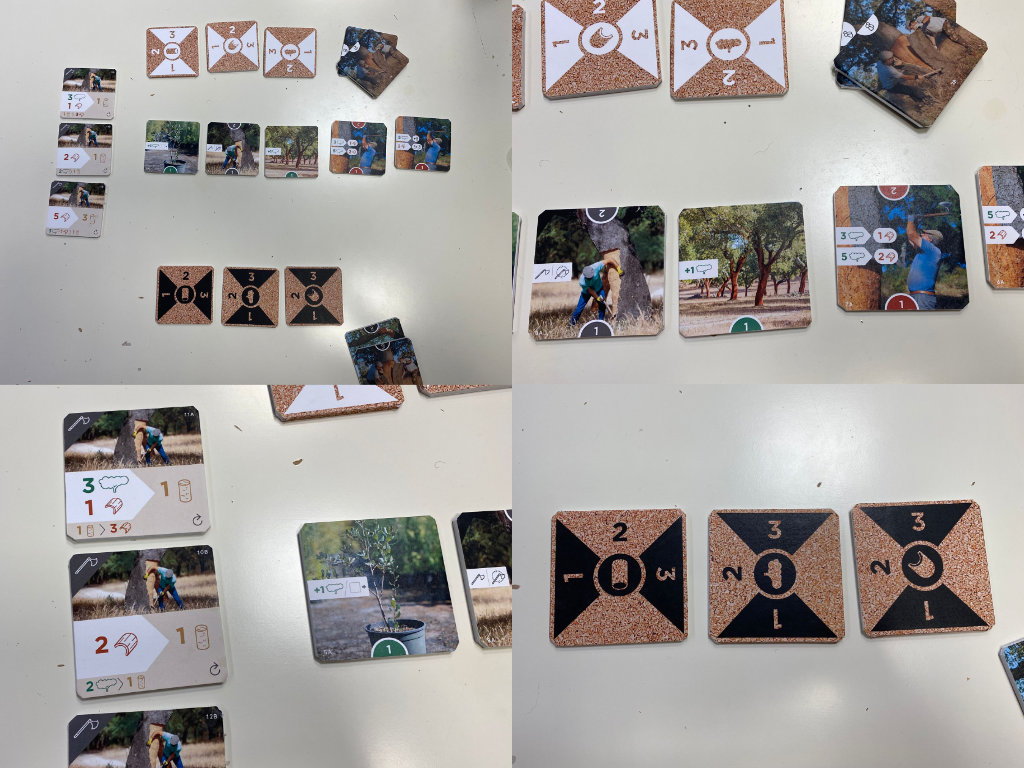
Gil wanted to make the game out of cork, which sounded wonderfully fitting! They investigated several options. The first was to make the cards out of cork, but the production costs would skyrocket. They looked into only making the resource cards out of cork, bringing the number down from 18 cards to 6. Then they took a different approach of having a cork box instead, then a cardboard box with a cork sleeve to keep the lid shut.

One of Mebo’s prototypes, with resource cards made of cork

In the end there was no option that would be cost-effective to produce, which meant they’d be forced to charge a price that would seem too high for a tiny game of only 18 cards. In that price bracket it would also be competing with much bigger games that are well established. They politely declined and returned the rights to me.

A few months later Jason Tagmire from Button Shy Games got in touch and showed interest in publishing Cortiça, which sounded great since it had been designed specifically for them. He handed the game to his playtesting team, who regularly sent me helpful feedback and suggestions.

Some of the most notable changes: 

  • The Action cards are no longer shuffled at the end of the round, with the first one getting turned over. Instead, the player whose worker is at the bottom of the pile gets to pick which action leaves the line on the next round. This gives the players more control, works as a catch-up mechanism and makes the game more strategic, giving players a better idea of what action cards might be available next and in what order, and letting players choose to have a sub-optimal round in order to cue up the next one in their favor. It also reduces the hassle of having to shuffle and rebuild the action line every round.
  • The Action cards are now horizontal instead of vertical. This gives the art more room to breathe and form a landscape on the table. It greatly simplified things by placing all of the action spaces on the bottom of the cards, which was a lot easier to parse.
  • The Plan cards now show what’s on the other side as well, so players don’t have to memorize them or flip them to check, revealing their plans.
  • The “Get Help” card is no longer a permanent upgrade. In tthe earlier version the players who did this early had such a big advantage that it was hard to catch up. It also meant that action card was pretty much useless once the players upgraded both of their workers. Now the action is cheaper but it doesn’t last as long. It’s a bet on your next turn, so use it well!
Sara Mena developing the art direction for Cortiça

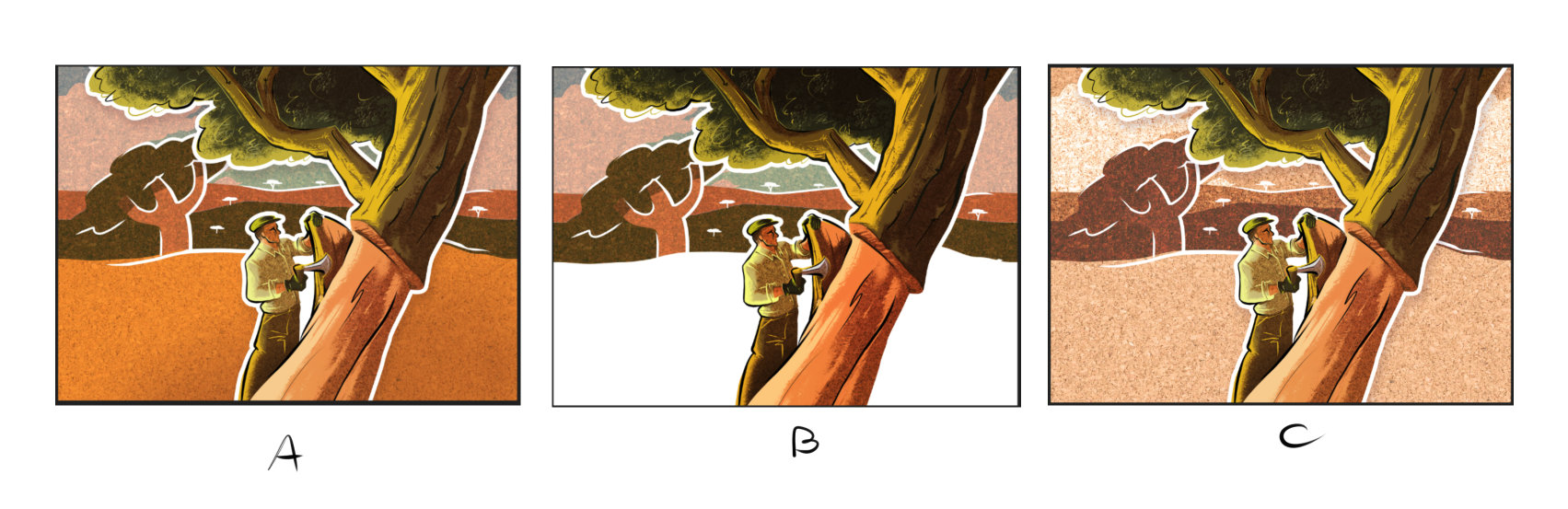
When it came time to think about the art, I mentioned I’d love it if the artist was Portuguese since they’d be more familiar with the topic, aesthetics and culture. I suggested Sara Mena, a talented artist who’s been an integral part of Cortiça’s development from the start, helping me with brainstorms, playtesting and overall support. She’s also my partner and we’ve long wanted to collaborate on a game. I was delighted that both Sara and Jason were up for it.

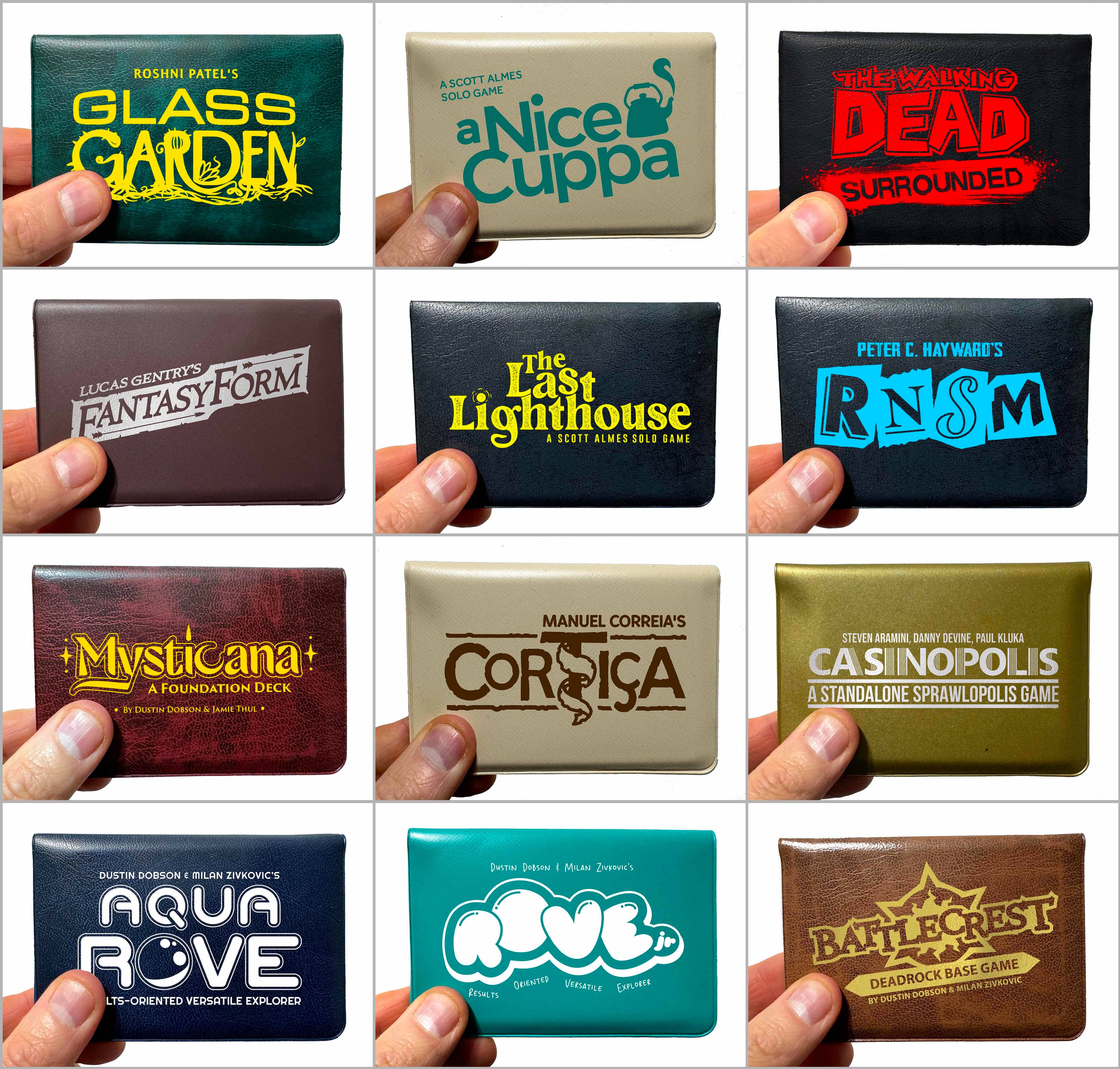
Cortiça’s wallet is revealed, in great company!

Once Button Shy posted the wallet design, everything was suddenly more real. It’s finally announced and people are wondering what it is. It’s happening! One step closer to the launch.

This design diary continues in Part 6 – Release.

If you don’t want to miss a post, you can subscribe to get them via e-mail:
Cortiça Part 4 – Design Challenge

boardgame, boardgame prototype, competition, Cortiça, designer tips, Empire of Sin, game design, Imirt

The deadline for Button Shy’s design challenge was fast approaching so it was time to prepare the materials to submit. The cards and rulebook were in a good state but there was one thing left to do: the pitch video. These videos are an important part of the process. Button Shy gets so many submissions for the challenges that they need these short videos in order to speed up their triage process. They’re also great practice for the designers so they can learn how to pitch their games and the video itself could be sent to publishers.

There were a few technical challenges. It was hard to find a place that didn’t create glare on the cards so I ended up recording on top of our bed, which meant I had to be on my knees. I had to rely on the camera’s microphone, which isn’t the best and left the sound a bit muffled.

Am I really that hard to understand?

I took the chance to try youtube’s automated subtitle feature, which is handy but gets confused with Portuguese names and words. Still, it was quicker to correct the transcriptions than to write everything from scratch.

Given the constraints, I’m happy with how it turned out. It gives you a quick overview of the game’s theme, rules and an example turn from the middle of the game, with five seconds to spare from the three minute limit.

Cortiça’s pitch video for the design challenge

I must add that I kept working on the game after the contest so these rules and cards don’t match the published version (spoilers!). I left it up as an example of a simple pitch video for other designers and people like you who are curious about how the game came to be.

Despite the demanding briefing there were over 150 games submitted to the design challenge! I was very happy that Cortiça made it to the 10 finalists but in the end the winner was Food Truck Feud, by Jay Yeates. It’s since been published by Button Shy as À la Food Cart.

Button Shy’s announcement video with the finalists and winner

At that time I was living in Ireland, and was a member of the board for IMIRT – The Irish Game Makers Association. One of my tasks was to help organize the IMIRT Irish Game Awards, which spotlight games made in the country. That year we were short on nominees, including for the Best Analogue Game category, which only had one. It was suggested I submit Cortiça.

I checked with the board before submitting because it could be seen as unfair since I was part of the organization, but since I was not a member of the Jury or part of the judging process, it was approved. I didn’t expect much because the other nominee was a published game with professional art. Mine was a tiny prototype, 18 handmade cards and rules in a ziploc bag.

Cortiça won Best Analogue Game and was the runner-up for Best Game Design at the Imirt Irish Game Awards 2020! 

They’re so pretty!

One of the big winners that year was Empire of Sin, by Romero Games. It won the awards for Best Game Design, Best Game Art and Best Technical Achievement, and was the runner-up for Best Game Narrative, Best Game Audio and Game of the Year. I was one of the game designers on the team! That was my day job. Cortiça was created in my spare time.

You can check the full list of winners and nominees here.

But that’s not where Cortiça’s story ends! There’s a couple more posts left to go.

This design diary continues in Part 5 – Publishers.

If you don’t want to miss a post, you can subscribe to get them via e-mail:
Welcome to The Machine

boardgame, boardgame prototype, game design, playtest, The Machine
The first prototype for The Machine

I’ve been working on a new prototype which I’m calling “The Machine”.

It started about a month ago. I wanted to make a game to play with my family, so it had to be accessible and easy to learn. It should fit into a small box. And I wanted the players to be able to change the rules as it’s being played. It’s something I’ve wanted to try for years, so why not give it a go?

You might be wondering “Isn’t that just Fluxx?”. Not exactly. Back when I first read about it, Fluxx sounded incredible! Fun concept, easy to teach and to set up. But when I played it I found it far too random. The game dragged on as players stole cards from each other and kept changing the goal. It made me think “What would my take on Fluxx be?”.

One of the challenges of a designing a game like this is that you have to make two games at the same time. There’s the game the players play from turn to turn and there’s the meta layer of rules which can be changed every so often. In a way, it’s similar to Fortune Tellers, a design I often return to but have yet to complete. You have to make sure that no matter how twisted the rules get, the game doesn’t get into a state where it cannot end.

To make it accessible, I started sketching rules on cards. I don’t want players to have to rely on their memory as the rules change, so they go on the table where everyone can see them.

I first played around with action programming and found that it could quickly get out of hand. If the rule sequences grew every turn, the game’s footprint would keep increasing, and so would the length of every turn. And if every player was too engrossed by their own sequence of rules, it would be a more solitary experience than I was after.

The first playtest of The Machine

I landed on the following: There is a line of action cards on the center of the table, which will resolve from left to right. On your turn you add a new card to the end of the line and resolve them in order. Then you take the first card into your hand. This allows the turns to keep changing without growing endlessly. Timing is an important factor, because when you play a good action it will stay in the line for a few turns and other players will get to use it too. Since there’s only a handful of actions the game is very easy to get into. The fun part is combining them in surprising ways.

This felt novel and exciting! However, research showed that a similar system had been used in the game Impulse, which was far more complex than I’d like this one to be. While not totally original, it felt like there was design space to explore.

It’s not easy to find a suitable theme for this game! There aren’t too many ways to explain a sequence of actions that you cannot rearrange, at least in a way that doesn’t feel forced. For now I went with: The players are factory workers who need parts to complete their orders. The parts are built by a machine that is very powerful but slow to adapt to change. Hence, “The Machine”.

I had never seen a system like this in action so I was very curious to try it out. I was shocked by how well the first playtest went. Teaching it was a breeze, the game went smoothly, the players liked it and it took exactly as long as I was going for. There was almost nothing to change!

It’s a good game but I think it would be great. I already have a few things in mind in order to make it more tense, exciting and allow for more varied strategies. Stay tuned!

If you don’t want to miss a post, you can subscribe to get them via e-mail:

Cortiça Part 3 – Playtesting

boardgame, boardgame prototype, competition, Cortiça, designer tips, game design

Now that I had a playable prototype (with a theme and everything!) it was time to show it to more players. This time however, I didn’t have a playtest group. Not only that, it was July 2020, the height of the COVID-19 pandemic. Everyone was at home in quarantine, and it would have been irresponsible to break it to get someone to playtest my game. Time to get creative!

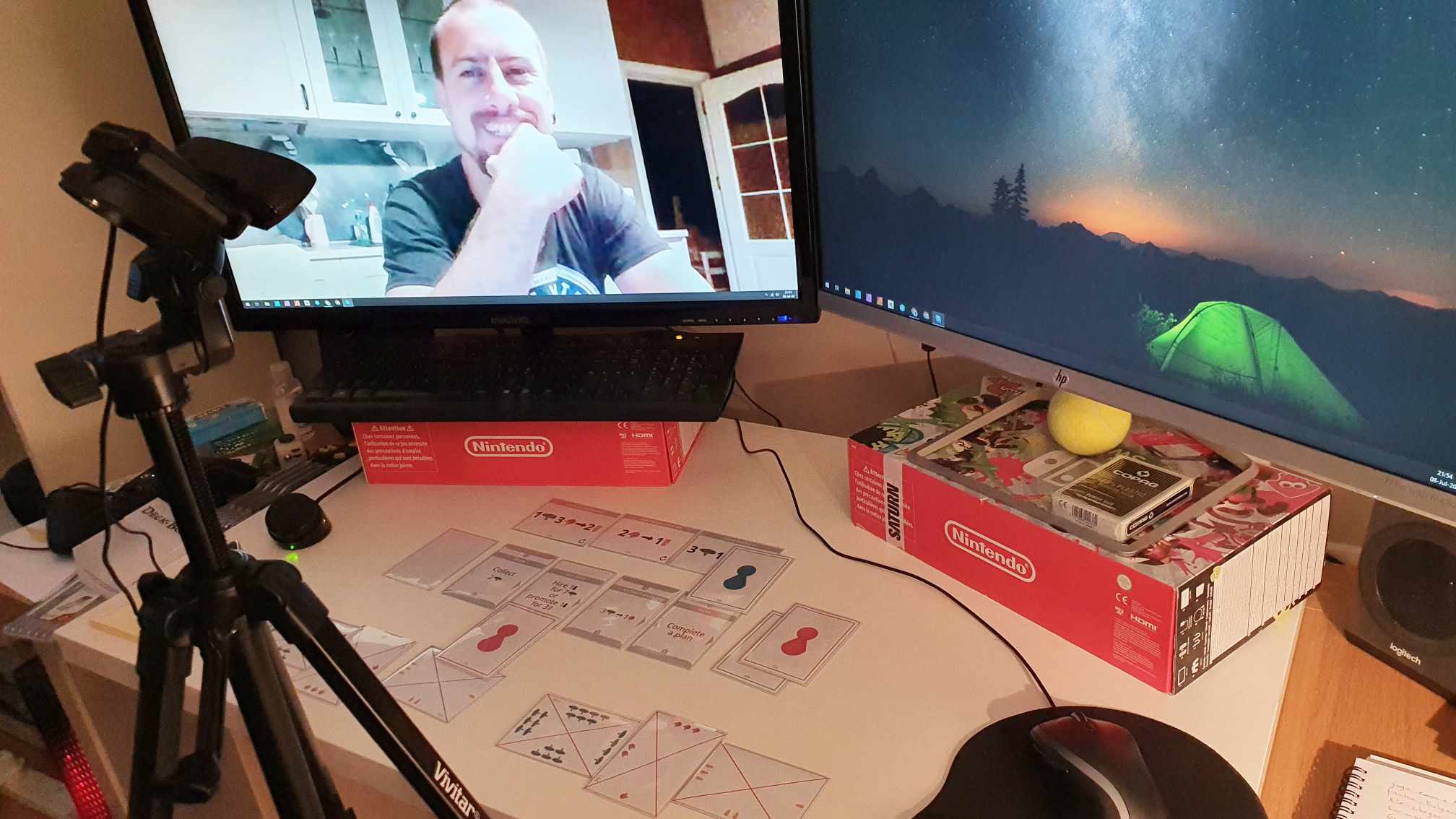
My cousin Miguel wanted to try it, so I improvised a setup with a tripod and a webcam in order to run a playtest through Skype. Since Cortiça has no hidden information, I could handle the cards for both of us. All he had to do was tell me his move.

Playtesting via webcam on an improvised streaming setup, on an improvised desk (Thank you, Ben!)

It worked but it was not ideal. The tripod had to be very close to the table and I had to be extra careful not to bump it with either my arms or my feet. It was tricky to light the cards without getting glare on the card sleeves and my camera’s resolution was a bit too low to keep up with the text on the cards. It was finally time to take Tabletop Simulator for a spin.

Recreating the game in Tabletop Simulator was straightforward. Once I had properly formatted files (one image with all the card fronts, another with all the backs), importing the cards was a breeze. That took care of the components! At this stage I didn’t want to get into scripting or automation because the game was still in a very fluid state where it could change drastically from one playtest to the next.

All the card fronts in one image, ready to import to Tabletop Simulator

Tabletop Simulator has a lot of potential but its interface often gets in the way, complicating simple things such as tucking a card under another. Even after learning its controls, it still feels like playing a game while wearing boxing gloves. This can affect playtests in a number of ways. Due to its cost and controls, the players who are willing to playtest are often very involved in the hobby. A more casual player would still have to go through its learning curve, and it will color their opinion of the game. In addition, games tend to run longer than they would with a physical prototype.

In this occasion though, it suited me very well. I was even able to find a workaround for several of the technical issues such as its price and interface. Just like my playtest with Miguel, I could run Tabletop Simulator on my machine and share my screen, moving the cards for both players. This allowed me to playtest with people that didn’t own Tabletop Simulator, and they didn’t even have to learn the controls!

Cortiça’s prototype on Tabletop Simulator

All the while I continued playtesting at home with Sara, always patient and supportive. The game took shape as we tried different strategies and made adjustments. My digital notes gradually turned into the game’s rulebook – but that’s a topic for the next article, where we’ll cover the contest submission.

This design diary continues in Part 4 – Design Challenge.

If you don’t want to miss a post, you can subscribe to get them via e-mail:

Cortiça Part 2 – Theme

boardgame, boardgame prototype, competition, Cortiça, designer tips, game design
The first prototype for Cortiça, handmade and still without a theme, or a name.

At the end of Part 1 I had a high level idea of how the game could work, but it hadn’t been tested and I had yet to define what it would be about.

At this point I could either look for a theme to design the game around, or try to get the game’s basic rules to work and then find a theme that fits. The good thing is, there is generally no wrong answer here. As long as they’re in tune in the end, you can start however you want.

Given the strict component count for the competition (18 cards!) there was a risk of falling in love with a theme that demanded more components, or that would make me want to stretch the definition of a worker placement game to the point where it would no longer qualify for the competition. Gameplay it is, then!

There was still one question left to answer before assembling the first prototype: I knew what 13 of the cards will be used for, but what about the other 5? I gave each player an additional resource type to allow for more depth in their actions. The other three were made into public double-sided goal cards which would change throughout the game. These were meant to add variability and to help prevent a dominant strategy, which is when you have a strategy that’s so powerful that there is no reason to do anything else. Watch out for those, they can sap all the fun out of a game!

The first playtest went well. The core system worked, the economy needed another pass (but that’s to be expected!), and the game took exactly one hour, which is a lot longer than I would like. After a few tweaks, it worked a lot better! It was finally time to start looking for a theme.

Putting together a prototype in Affinity Designer

As I wrote in Part 1, I wanted this game to be about a facet of Portuguese culture that I hadn’t seen represented in boardgames before. Turns out, there are plenty of those! After a fun brainstorm session with Sara Mena, we ended with an A4 page full of possibilities. There was one tricky aspect, however…

The core of the game is resource conversion, which could suggest a theme of harvesting or manufacturing something, but there is an extra wrinkle that doesn’t line up with the standard manufacturing process. In the game you use your workers to gather A to turn into B, which you can use to get C. Think of C as points: once you reach a specific amount, you win. There are several ways to turn combinations of A and B into C, but you can also can turn C back into a larger amount of B! That’s because I wanted to give players the option to spend their hard-earned points for a chance of getting even more later on – but will they have enough time to do it? This could also work as a catch-up mechanism, because it gives a losing player a chance to sprint ahead.

The obvious solution would be for C to be money, so exchanging it for B could represent buying it, but since getting C is the goal of the game, that could easily be interpreted as “money is good”, and I did not want that at all. I’d much prefer if my game could help people forget about capitalism for a bit.

Fortunately, there was one theme on the list that could fit all of the gameplay so far: Cork!

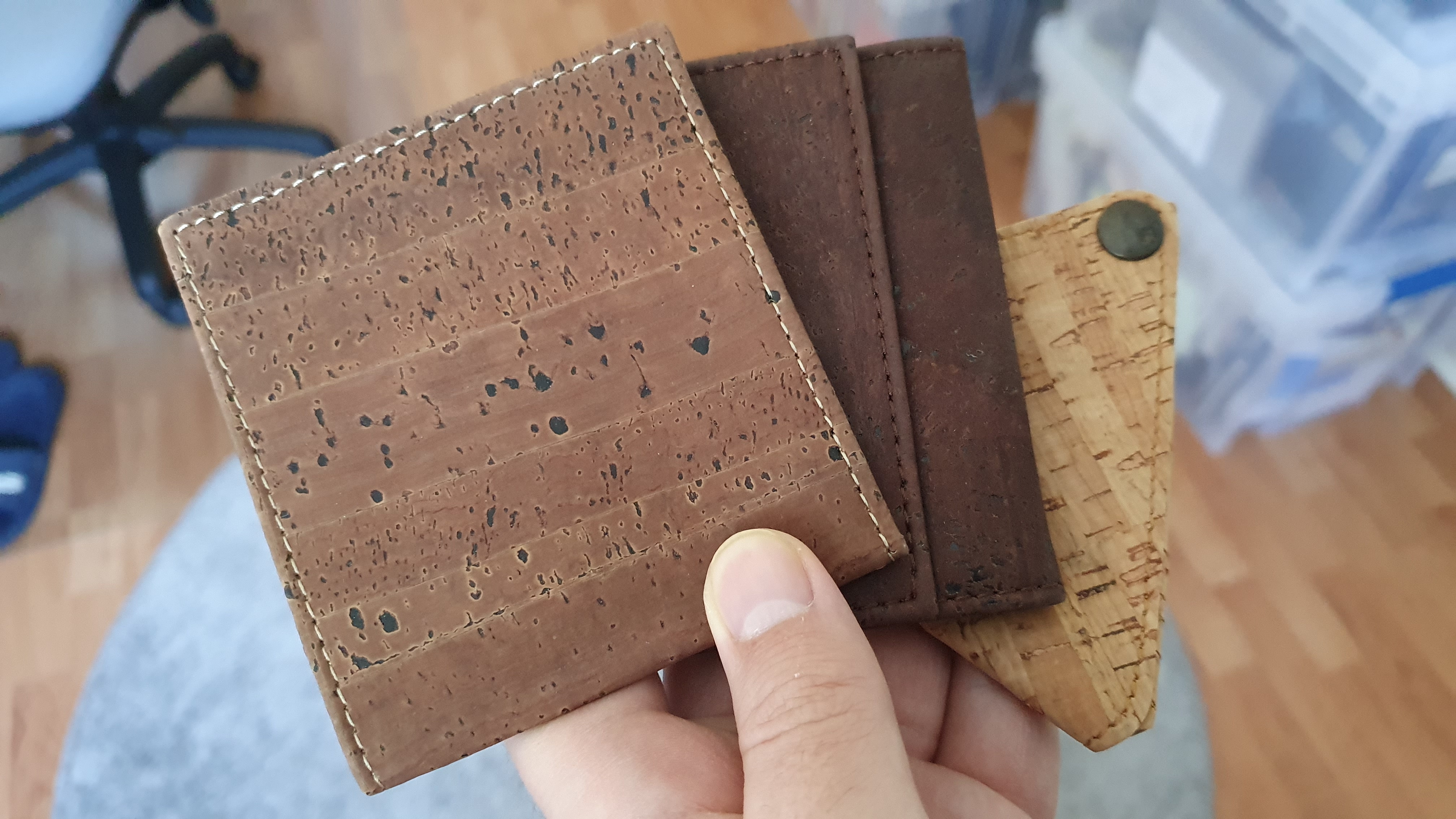
Three wallets made out of cork fabric.

Cork is a big deal in Portuguese culture. You may have only seen it as wine stoppers, but has long been used to make tools and the recent invention of cork fabric has greatly expanded its possibilities. Not only can you make things like wallets, umbrellas, hats and even postcards out of it, but it can also be recycled.

So now I have a theme! When applied to my game, the result is: The players will assign their workers to grow cork oaks, extract the bark and process it into different products made out of cork. Players can also recycle their cork, which gives them raw material which they can turn into other products. I also had a name: “Cortiça” (/kuɾˈti.sɐ/), the Portuguese word for Cork.

On the next design diary we’ll cover playtesting during a pandemic: Part 3 – Playtesting.

If you don’t want to miss a post, you can subscribe to get them via e-mail:

Cortiça Part 1 – Origins

Blight Chronicles, boardgame, boardgame prototype, competition, Cortiça, designer tips, game design
Photo of a cork oak tree in a dry Alentejo field, by António Carrapato

At long last, let’s talk about Cortiça! What is it, and where did it come from?

After Blight Chronicles: Agent Decker wrapped up, I was done. It was such a negative experience that it left me incapable of working on my own projects for a while. It taught me what a panic attack was, even if I didn’t have a name for it yet. Every so often I’d come up with an idea for a mechanism or a theme that seemed interesting and would write them down, but as soon as I started to develop it into a prototype, there would be instant splitting headaches and my heart rate would go up. The message was clear, I had to take a break. This was supposed to be a hobby. This was supposed to be fun.

This went on for a few years.

It had been almost eight years since me and my partner moved abroad for work. I wouldn’t describe myself as a patriotic person, but as time went on I started to miss facets of Portuguese culture that couldn’t be found anywhere else. It was heartwarming to see new, popular boardgames using Portuguese themes but they seemed to focus on just a few aspects of the culture such as wine and azulejo tiles. There’s so much more! One day I brought this up on Twitter and a random user responded with an angry version of “If you’d like to see more games with Portuguese themes, why don’t you make one?”. I think they were just trying to shut me up, but I wanted to make something to answer back. Is it wrong to make a game out of spite?

In June 2020, Button Shy Games announced a new design contest: “Create an 18 card worker placement game. Cards only.“. This seemed impossible! Worker placement games usually have plenty of tokens for workers, currency, resources, sometimes even victory points! How can you compress it all into only 18 cards? It got my brain going. I still wanted to take things easy so I didn’t commit to the contest right away, but I had to see if I could crack this puzzle.

Boardgame designers often get asked “Do you start with the theme or the mechanics?”. In this case the component constraint was just as important. If it can’t fit those cards, it’s no good. So I started to do research on worker placement games. I had to get to the essence of what makes them work, because there wouldn’t be room for much more. Action drafting, timing, blocking, action resolution, collecting and converting resources, multiple paths to victory. In 18 cards…!

This needed a new approach. I figured one way to make sure the game would fit into 18 cards was to sketch what it could look like while in play. This really helped! I still didn’t know what the game was about or how it played, but this let me allocate cards for different functionalities to see how many I would need for a basic worker placement game. After multiple attempts on paper I moved to the computer and sketched something that started to look like a game:

Mock screenshot of Cortiça

There is a central row of action cards with one or two slots where you can place workers. Each player has their own worker and resource cards, in their color. Workers are double-sided so they could be upgraded. Resources are counted by rotating the card. The amount on the top edge is your current total and they’re double-sided, so each card can count up to seven. And the best part is, I have five spare cards!

Now that I had an idea of the general shape and limits of the game, I could start to figure out what it is about, and how it plays.

This design diary continues in Part 2 – Theme.

If you don’t want to miss a post, you can subscribe to get them via e-mail:

Long time no see!

Blight Chronicles, boardgame prototype, Cortiça

Hey everyone!

Remember this blog? It’s been a while since I posted regularly about what I’ve been working on. Sure, there was the odd update and catch-up here and there, but there was so much that wasn’t mentioned here, from new game prototypes, to a new design being picked up by two publishers and even winning an award before it was out!

Why did I stop posting? Let’s get into it.

If you follow me on Twitter, you might have seen me talk about most of these things. It was so easy to tweet a photo or a quick note about something, compared to writing a proper post here, and there was an eager audience that engaged with it. But at the rate that Twitter is imploding, I can’t count on it being there for very long. So I will be turning some of those tweets and threads into blog posts, and possibly turning Twitter URLs into screenshots instead, to make them more future-proof. Also, if you follow me on Twitter I’d like to ask you to follow me on Mastodon instead, because I’m not using Twitter anymore.

I still work in videogames during the day, just as I have for the last 13 years. Doing so has required five international relocations so far, which certainly had its fun aspects but it also meant having to leave my design group and playtesters behind more than once. It’s no coincidence that my games started focusing on smaller player counts. They’re the ones I can playtest at home.

Last but definitely not least, I spent several years working with a very controlling boardgame publisher who kept their eye on my social media and complained whenever I posted about other projects, so I stopped posting – but I didn’t stop sketching other games. I had to. It was the only creative outlet during those years working on games I did not want to make. It burned me out and I’m still recovering, so naturally the pace has had to change.

That chapter is over. I’m not working with them anymore, the games are out of print and the rights have reverted back to me. But I am getting ahead of myself. I’ll have more to say about that later.

So welcome back, and I hope you stick around for the new posts!

If you don’t want to miss a post, you can subscribe to get them via e-mail:
MIND IS SOFTWARE – Porting SUPERHOT from the screen to the table

Agent Decker, boardgame, boardgame prototype, crowdfunding, designer tips, game design, Superhot, Talks

Every so often I look for talks about the process of designing games and only found a few. Maybe I’m spoiled by all the postmortems that happen in the videogame medium but I’d love to see something similar from boardgame designers, especially about working with IP or adapting games from one medium to another.

So when Gamedev Camp invited me to do a talk and let me pick the topic, I knew what I had to do! I went with the design process of adapting SUPERHOT from a videogame to a card game.

I hope you find it insightful!

Return to Fortune Tellers

boardgame prototype, Fortune Tellers
The second prototype for Fortune Tellers, 2013

Fortune Tellers is a game I’ve been thinking about for eight years.

Back then I tried two different prototypes. The concept had potential but the gameplay had flaws that I didn’t know how to solve at the time. It was enticing and intimidating, much bigger than the ones I had made before. Shortly thereafter I had to move out of the country and left it behind.

I still think of it regularly because the theme makes me laugh and because – as far as I know – there hasn’t been another game like it. Since it’s something I’d still like to play, I guess I’ll have to make it myself. I hope the added experience will help to cross the gameplay bump.

So, what is this game about? Here is the synopsis:

You are the village’s fortune teller. For years people have come to you in search of insights about health, relationships, business and more.

…until there was something you didn’t see coming: a second fortune teller set up shop in the village and your steady stream of clients has turned into a drip. It’s time to put your skills in practice and regain your reputation!

The only way to make points is by correctly predicting the future. You’ll write predictions, place them face down on the table and then will try to get the other players to do the things you wrote. When they come true, you get to say “Aha!”, show them the prediction and get to feel very smug.

The main design challenge in this project is that there needs to be another game to make predictions about. One lives inside the other and they need to work together. The game needs to have actions that can be predicted, but can’t feel too constrained.

I’m swapping the worker placement mechanic of the original for a rondel and an area majority game to emulate word of mouth around the village. Just like with Cortiça, I started by making a mockup “screenshot” of what it could look like during play to help visualize the full game and how many components it would require. This is what it currently looks like:

Current mockup for Fortune Tellers, 2021

The next step is to turn it into a prototype so it can be playtested. Since the pandemic is still going it will have to be digital, which is a good excuse to finally learn my way around Tabletop Simulator to playtest online. Maybe you’ll get to play it!

Stay tuned!